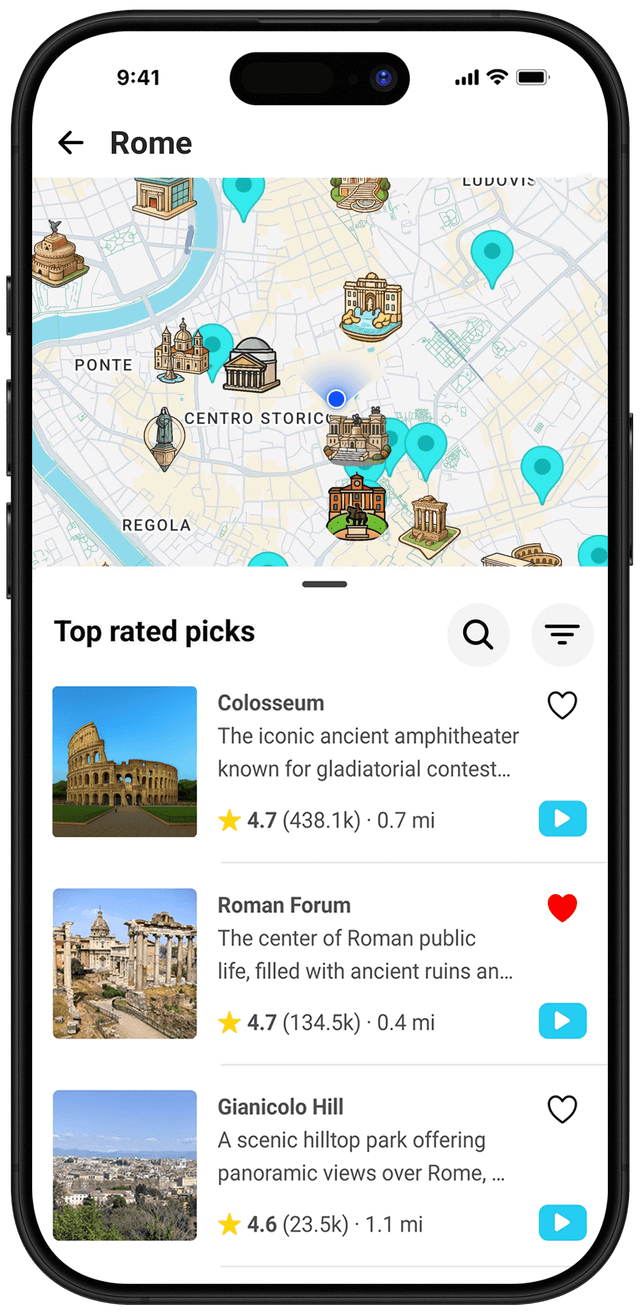


4 Days in Rome: History and Memory
4 Days in Rome: History and Memory
Day 1: The Rise of Imperial Power
This day explores the physical and symbolic center of ancient Rome, tracing how political authority, spectacle, and urban design reinforced the dominance of the empire.
Morning and Early Afternoon
Optional add-on: Visit Basilica di San Clemente, which offers a vertical journey through time, with layers of medieval, early Christian, and Roman structures beneath one another. Requirements for respectful/modest attire apply at churches and other religious sites. Visitors should avoid disrupting religious observances and remain mindful of posted customs.
Begin at the Colosseum, the empire’s grand amphitheater where mass entertainment reinforced imperial authority and social order.
Pass the Arch of Constantine, a triumphal monument marking both military victory and Rome’s transition toward Christianity.
Continue through the Roman Forum and Palatine Hill, the intertwined political, religious, and residential core of Rome, where senators debated, emperors ruled, and myths of Rome’s founding took shape.
Optional add-on: Visit the Mamertine Prison, an ancient holding site associated with defeated enemies and with the imprisonment of Saints Peter and Paul.
Late Afternoon
Climb to Capitoline Hill, one of Rome’s original seven hills and a longstanding seat of civic power. Explore Piazza del Campidoglio, redesigned by Michelangelo to reflect Renaissance ideals layered atop ancient foundations.
Visit the Capitoline Museums, home to some of the most important surviving sculptures and artifacts from antiquity, including the Bronze She-Wolf, offering insight into how Romans represented power, identity, and mythology.
Evening
Head to Piazza Venezia, a modern traffic hub that sits at the crossroads of ancient and modern Rome. Spend time at Altare della Patria (Vittoriano Monument), a tribute to unified Italy that reflects how later eras reinterpreted Rome’s imperial legacy for national identity.
Day 2: Roads, Empire, and Memory
This day moves beyond the city center to examine how Rome expanded and governed during ancient times and also incorporates significant places from modern history.
Morning
Rent a bike to explore the Via Appia Antica, or the Appian Way, one of the oldest Roman roads, where ancient paving stones still guide the route. Visit the Catacombs of San Callisto, an underground burial network reflecting early Christian practices.
Other highlights include the Circus of Maxentius, a preserved chariot racing stadium, the Mausoleum of Cecilia Metella, a monumental mausoleum, and the Villa dei Quintilii, once a luxurious imperial estate.
Requirements for respectful/modest attire apply at churches and other religious sites. Visitors should avoid disrupting religious observances and remain mindful of posted customs.
Optional add-on: Visit the Parco degli Acquedotti where aqueducts stretch across open landscapes, highlighting Roman engineering.
Afternoon
Visit the Mausoleo delle Fosse Ardeatine, a memorial marking the site of a Nazi massacre during World War II. The caves and tombs stand as a reminder of occupation, resistance, and collective memory in modern Rome.
Evening
Optional add-on: Visit the Jewish Museum of Rome, to examine artifacts, textiles, and archives documenting thousands of years of Jewish life in Rome, and the attached Great Synagogue of Rome with its distinctive architecture.
Explore the Ghetto Ebraico di Roma, or the Jewish Quarter, an area shaped by centuries of resilience and cultural continuity. Find a place for dinner and sample one of the neighborhood specialties, carciofi alla giudia (fried artichokes).
End the evening at Gianicolo Hill, which offers one of the city’s most peaceful panoramic views from the site of a pivotal battle between the Roman Republic and the French.
Day 3: Daily Life Beyond the Capital
Examine daily life outside Rome’s monumental core, exploring how ordinary people lived, worked, and relaxed in both urban and suburban settings.
Day
Optional add-on: Visit the Baths of Caracalla, vast public bath complexes that functioned as social and recreational hubs of everyday life. Mosaics, vast vaulted spaces, and remnants of heating systems are still intact.
Travel to Ostia Antica, Rome’s ancient port city, where preserved streets, homes, shops, and bathhouses provide a picture of everyday Roman life beyond the capital.
Evening
Return to Rome and spend the evening in Trastevere, a neighborhood that retains a more local, lived-in character, with narrow streets and a vibrant dining scene layered over centuries of history.
Day 4: Imperial Retreats and Enduring Legacy
Discover how Rome’s elite spent time outside of the city, before returning to the historic center to reflect on the continuity of Roman influence.
Day
Travel to Tivoli to visit Villa Adriana (Hadrian’s Villa), an expansive imperial retreat that recreates landscapes and architectural styles from across the empire, reflecting both power and personal vision. Check dress codes before visiting.
Optional add-on: Visit Villa d’Este, a Renaissance villa famed for its elaborate terraced gardens and fountains, showing how later elites reinterpreted Roman ideas of luxury and landscape.
Evening
Return to Rome and explore Piazza Navona, a Baroque square built atop an ancient stadium, where layers of history remain visible in its form.
End at the Pantheon, a masterpiece of ancient engineering that has remained in continuous use for nearly two millennia, a symbol of Rome’s lasting architectural and cultural legacy. Requirements for respectful/modest attire apply at churches and other religious sites. Visitors should avoid disrupting religious observances and remain mindful of posted customs.
Options for Bad Weather
In case of bad weather, visit the:
- Galleria Nazionale d'Arte Antica - Palazzo Barberini to explore a 17th-century palace with an extensive art collection, including works by Caravaggio, Raphael, and Bernini
- Galleria Doria Pamphilj to view masterpieces in a historically preserved palace
- Palazzo Altemps, a Renaissance palace filled with ancient sculpture
Make the most of your trip with the Travi App
Audio Guides
Professional narrated stories that you can listen to on your own schedule.
Snap & Learn
Point your camera at any monument to instantly identify it and hear its history.
Itineraries
Browse curated day-by-day plans, customize them to fit your style, or build your own from scratch and share with friends.