

4 Days in Prague: History and Memory
4 Days in Prague: History and Memory
Day 1: Royal Power and the Medieval City
This day traces the foundations of Prague’s political and religious authority, moving from the medieval urban core to the seat of royal and imperial power.
Morning
Begin the day at Prague Castle, the political and symbolic heart of the Czech state for over a millennium. Within the complex, head to St. Vitus Cathedral with its soaring Gothic interior expressing both religious devotion and dynastic ambition.
Requirements for respectful/modest attire apply at churches, synagogues, and other religious sites. Visitors should avoid disrupting religious observances and remain mindful of posted customs.
Also visit Old Royal Palace, where Vladislav Hall stands as a masterpiece of late Gothic engineering. Its vast ribbed vaulting once hosted coronations, banquets, and even indoor jousting tournaments.
Optional add-on: Take a brief walk along Golden Lane, a row of small, colorful houses that once housed castle workers and artisans.
Afternoon
Move into the historic core of the city, crossing the Charles Bridge. Lined with baroque saints, it physically and symbolically connects royal authority with the life of the city.
Head to Old Town Square, the historic heart of Prague, surrounded by colorful facades and anchored by the Prague Astronomical Clock, a medieval timepiece that draws crowds for its hourly Walk of the Apostles show. Ascend the tower for a view that reveals the city’s layered development.
Nearby, step into the Church of Our Lady before Týn, whose twin Gothic spires define Prague’s skyline. Requirements for respectful/modest attire apply at churches, synagogues, and other religious sites. Visitors should avoid disrupting religious observances and remain mindful of posted customs.
Evening
Head to Malá Strana, where the district was largely rebuilt in the Baroque era and reflects the era of Habsburg rule and Catholic renewal. End the evening at Café Slavia, a historic café long associated with artists, writers, and dissidents.
Day 2: The Holocaust and the Czech Resistance
Explore Prague’s Jewish heritage and the impact of Nazi occupation, alongside key sites connected to resistance and wartime history.
Morning
Begin in the historic Jewish Quarter, where a group of preserved sites reflects centuries of Jewish life in the city. Visit the Pinkas Synagogue, where the names of nearly 80,000 Czech and Moravian Holocaust victims line the walls. Continue to the Old Jewish Cemetery, where layered gravestones create one of the most distinctive historical landscapes in the city.
Step into the Old-New Synagogue, one of the oldest active synagogues in Europe, then the Židovské muzeum v Praze - Maiselove Synagoga, where exhibitions trace the history of Jewish life in Bohemia and Moravia.
Together, these sites form one of the most powerful and concentrated Holocaust memory landscapes in Europe. Use discretion when choosing which exhibits to visit, as some displays may be intense.
Requirements for respectful/modest attire apply at churches, synagogues, and other religious sites. Visitors should avoid disrupting religious observances and remain mindful of posted customs.
Afternoon
Optional add-on: Head to Petschkův Palác or Petschek Palace, once the headquarters of the Gestapo, for an exterior visit. The building itself remains largely unchanged.
Continue to the Orthodox Cathedral of Saints Cyril and Methodius, where the crypt tells the story of the Czech resistance fighters involved in the assassination of Reinhard Heydrich during Operation Anthropoid. Use discretion when choosing which exhibits to visit, as some displays may be intense.
Optional add-on: Stop at the Heydrich Curve, which was the location of the ambush, at the intersection of v Holešovičkách and Zenklova streets.
Evening
End the day with a walk along the Vltava River near the National Theatre. The river, illuminated buildings, and slower pace provide space to process the weight of the day.
Day 3: Communism, Dissent, and Civic Courage
Examine life under communism and the intellectual and civic movements that ultimately led to democratic transformation.
Morning
Begin outside the building of the former StB holding cells at Bartolomějská Street (Bartolomějská 10/14) to provide context for the surveillance and control used under the communist regime. Continue to the Museum of Communism, which provides further context for daily life under authoritarian rule.
Walk through Wenceslas Square, a central stage for modern Czech history. Here you’ll find the Jan Palach and Jan Zajic Memorial, whose deaths by self-immolation in 1969 became a defining act of protest following the suppression of the Prague Spring.
Nearby, the memorial at 17.11.1989 Velvet Revolution Plaque marks the site where a student demonstration in 1989 was violently suppressed, which helped to spark the Velvet Revolution.
Afternoon
Follow the intellectual and cultural world of Václav Havel by visiting Na Zábradlí Theatre, where his plays were staged, and Lucerna Palace, which is associated with his family.
Evening
End the day at Letná Park, where sweeping views over the Vltava River and the city’s bridges offer a sense of perspective. This was once the site of a massive Stalin monument that has since been removed, making it a fitting place to reflect on the rise and fall of political systems.
Day 4: Terezín’s History and Legacy
This day focuses on the history of Terezín, a former garrison town later used during the Nazi occupation, with attention to daily life and historical context.
Day
Take a day trip to Terezín, a former Hapsburg garrison town transformed into a Nazi ghetto and transit camp. At the Terezín Memorial, visit the Ghetto Museum and the Magdeburg Barracks, where exhibitions document daily life, cultural expression, and survival under extreme conditions. Use discretion when choosing which exhibits to visit, as some displays may be intense.
Optional add-ons: Stop at the Small Fortress, which was used as a Gestapo prison.
Late Afternoon/Evening
Return to Prague and visit Vyšehrad in the late afternoon. Spend some time in the cemetery and then walk the ramparts as the city quiets and the light fades.
Options for Bad Weather
In case of bad weather, visit the:
- Prague Planetarium for interactive exhibits on space history and its state-of-the-art LED dome
- CAMP (Center for Architecture and Metropolitan Planning) for changing exhibitions on topics like urban planning, city sustainability, and ecology
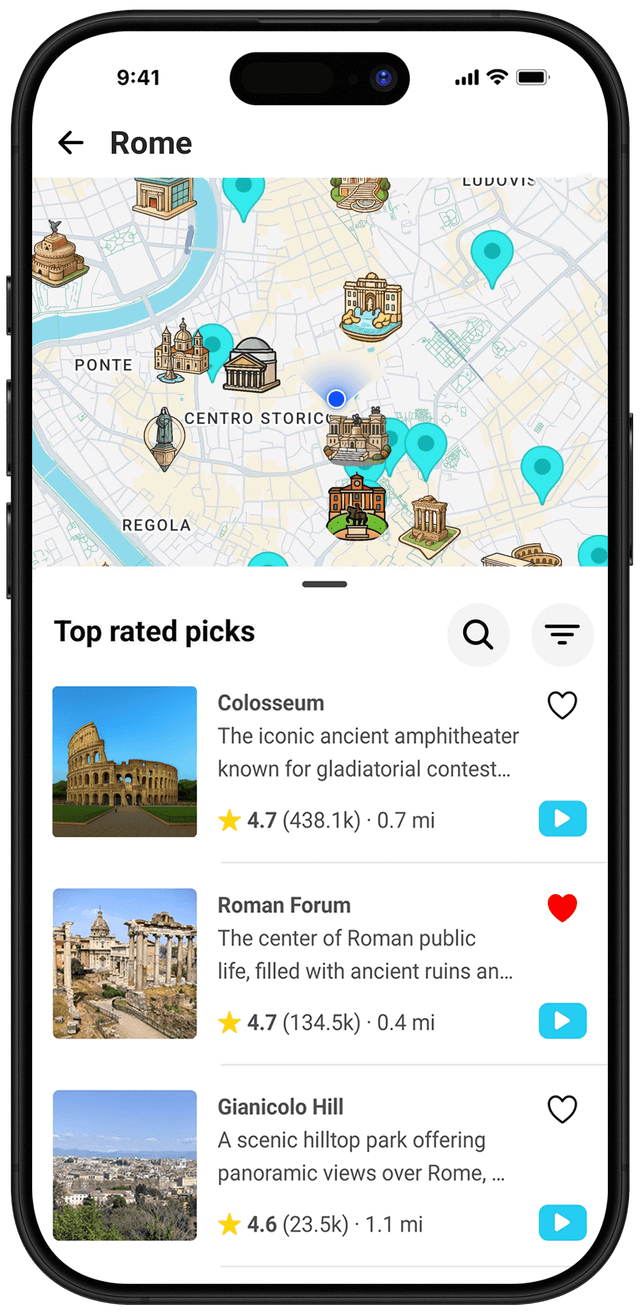
Make the most of your trip with the Travi App
Audio Guides
Professional narrated stories that you can listen to on your own schedule.
Snap & Learn
Point your camera at any monument to instantly identify it and hear its history.
Itineraries
Browse curated day-by-day plans, customize them to fit your style, or build your own from scratch and share with friends.