

3 Days in Madrid: History and Memory
3 Days in Madrid: History and Memory
Day 1: Imperial and Royal Madrid
Trace Madrid’s transformation from a medieval settlement into the capital of a global empire through royal spaces, historic plazas, and Habsburg-era streets.
Morning
Begin at Puerta del Sol, the symbolic center of Madrid, which has evolved from a city gate into the political and geographic heart of Spain. It is marked today by civic buildings, monuments, and the famous Kilómetro Cero marker from which Spain’s national roads are measured.
Continue onward to Plaza Mayor, the grand arcaded square associated with Habsburg Madrid. Historically, the plaza hosted markets, festivals, royal ceremonies, bullfights, and inquisitorial events, reflecting the ceremonial and political life of imperial Spain.
Walk through the older streets surrounding Plaza de la Villa, one of the city’s best-preserved medieval and early modern areas. The square contains several historic civic buildings tied to Madrid’s role before and during its rise as the royal capital under the Habsburg monarchy.
Optional add-on: Visit Lope de Vega Casa Museo, the preserved home of playwright Lope de Vega, one of the central literary figures of Spain’s Golden Age.
Afternoon
Spend the afternoon exploring the Royal Palace of Madrid, the official royal residence used for state ceremonies and one of Europe’s largest palace complexes. Lavish interiors, throne rooms, ceremonial halls, armor collections, and frescoes illustrate the power, wealth, and dynastic ambitions of the Spanish monarchy.
Continue to the Royal Collections Gallery, whose exhibits include tapestries, paintings, armor, furniture, religious objects, and royal decorative arts accumulated across centuries by Spanish monarchs.
Optional add-on: Visit the Almudena Cathedral, whose blend of neoclassical, Gothic Revival, and modern architectural elements reflects Madrid’s comparatively late cathedral construction history. Requirements for respectful or modest attire apply at churches and other religious sites. Visitors should remain mindful of ongoing religious observances and posted customs.
Evening
Conclude the evening at Café de Oriente Palacio Real, located beside Plaza de Oriente with views toward the Royal Palace and an ornate interior with Belle Epoque decor.
Day 2: Civil War, Dictatorship, and Democratic Memory
Examine Madrid’s past through the lenses of war, dictatorship, resistance, and democratic transition during the twentieth century.
Morning
Begin at the Museo Nacional Centro de Arte Reina Sofía to examine the cultural and political trauma of the Spanish Civil War through works such as Picasso’s Guernica, alongside art connected to exile, authoritarianism, and modern social change.
Continue to Ciudad Universitaria, one of the principal battle zones during the Siege of Madrid in the Spanish Civil War. Fighting between Republican and Nationalist forces devastated much of the university district, and traces of bunkers, memorials, and wartime geography still survive in parts of the area today.
Afterward, visit the Monumento en homenaje a las víctimas del 11M at Atocha Station, commemorating the victims of the 2004 Madrid train bombings.
Afternoon
Head to Lavapiés, a historically working-class and multicultural neighborhood associated with migration, political activism, and countercultural life. Explore the area’s streets, murals, and community atmosphere before stopping at Mercado de San Fernando, a neighborhood market combining traditional vendors with independent cultural and food spaces.
Optional add-on: Nearby, visit Cine Doré, the historic cinema that now houses the Spanish Film Archive. Its restored early twentieth-century interiors and programming reflect Madrid’s long cinematic and intellectual traditions.
Continue to the Sacramental Cemetery of San Isidro, one of Madrid’s oldest cemeteries and the burial place of artists, politicians, aristocrats, and intellectuals connected to Spain’s modern history.
Finish the afternoon at the Madrid History Museum, whose exhibits trace Madrid’s urban development from its origins through the Bourbon era, nineteenth-century modernization, civil conflict, and democratic transformation.
Evening
Have dinner at Taberna Antonio Sánchez, one of Madrid’s oldest surviving taverns and a longtime gathering place associated with bullfighting culture, writers, and traditional Madrid social life.
Optional add-on: End the evening at La Venencia, a historic sherry bar famous for its links to journalists, intellectuals, and Republican sympathizers during the Civil War era.
Day 3: Archaeology and Ancient Foundations
Explore the deeper historical layers of Madrid and the Iberian Peninsula through archaeology, ancient civilizations, and the city’s earliest origins.
Morning
Begin at the National Archaeological Museum, one of Spain’s most important museums for ancient history and archaeology. Its collections span prehistoric Iberia, Roman Hispania, Visigothic kingdoms, Al-Andalus, and early medieval Spain, including sculpture, mosaics, jewelry, ceramics, inscriptions, and funerary artifacts.
Continue to the Museo de San Isidro Los Origenes de Madrid, which focuses on the origins and early history of Madrid from prehistoric settlement through the Islamic and medieval eras. Archaeological remains, maps, ceramics, and models illustrate how Madrid developed from a frontier settlement into an emerging urban center.
Afternoon
Optional add-on: Visit the remains of the Arab Walls, or Mayrit Wall, near the Royal Palace area to see surviving sections of Madrid’s Islamic fortifications, built during the Umayyad period when the city originated as the frontier settlement of Mayrit.
Spend the afternoon at the Temple of Debod, an ancient Egyptian temple relocated to Madrid in the twentieth century as a gift from Egypt following Spanish archaeological assistance during the construction of the Aswan High Dam. The surrounding park also provides one of the city’s best panoramic viewpoints overlooking western Madrid and the Casa de Campo landscape.
Evening
Conclude the trip at the rooftop terrace of the Círculo de Bellas Artes, where sweeping views across Gran Vía and central Madrid offer a final perspective on the layers of history explored throughout the trip.
Options for Bad Weather
In case of bad weather, visit the Museo Cerralbo for preserved aristocratic interiors, decorative arts, paintings, armor, and furnishings reflecting nineteenth-century elite life in Madrid.
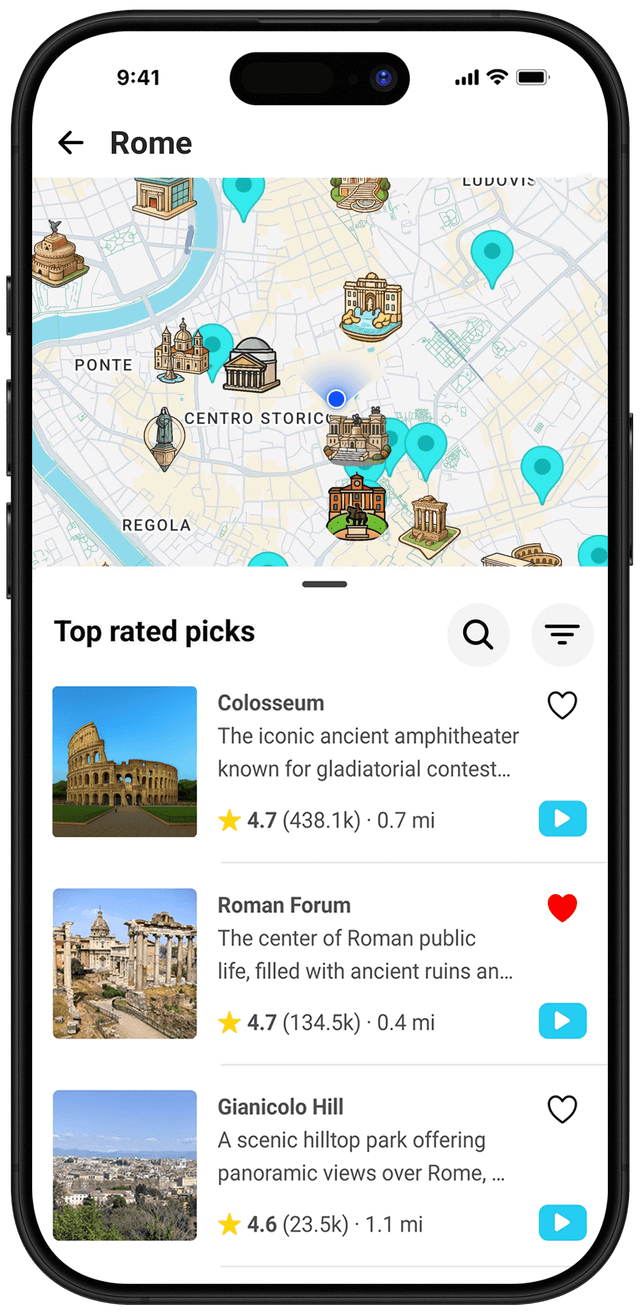
Make the most of your trip with the Travi App
Audio Guides
Professional narrated stories that you can listen to on your own schedule.
Snap & Learn
Point your camera at any monument to instantly identify it and hear its history.
Itineraries
Browse curated day-by-day plans, customize them to fit your style, or build your own from scratch and share with friends.